Geopolitical Tensions and the Rise of the Dynamic Value Chain
Designing Aligned Supply Chains for a Geopolitically Fragmented World
Geopolitical Tensions and the Rise of the Dynamic Value Chain
Global supply chains have entered a phase of sustained instability or persistent volatility. Trade fragmentation, regional conflict, sanctions, industrial policy, and energy insecurity are no longer temporary disruptions but have become a permanent design variable in today’s operating environment. The resulting disruptions are not anomalies to be absorbed; they are signals that the logic underpinning many value chains is outdated they are structural characteristics of the contemporary operating environment.¹ For senior leaders, the central challenge is no longer restoring stability, but sustaining value creation under conditions of persistent uncertainty. This shift exposes a fundamental misalignment. Many value chains remain designed for a geopolitical context that no longer exists.
From Efficiency to Fit in a Fractured World when Optimization Stops Working
For decades, value chains were optimized around cost efficiency, scale, and predictability. These designs reflected assumptions of open markets, relatively neutral geopolitics, and stable trade regimes. Geopolitical tensions have reshaped flows of materials, capital, data, and talent. Near-shoring and “friend-shoring” alter cost structures. Export controls constrain technology access. Centralized networks and long planning horizons were logical outcomes of this environment.²
Those assumptions have eroded. Access to materials, technology, and markets is increasingly shaped by political alignment rather than comparative advantage alone. Logistics routes can be disrupted or repriced with little notice, and regulatory regimes now vary sharply across regions.³ The result is a widening gap between how value chains are configured and what markets require. Emphasizing that traditional, one-size-fits-all supply chains—optimized primarily for cost—are ill-suited for this environment. The Dynamic Value Chain reframes the problem: value is not created by efficiency alone, but by continuous alignment between customer demand, behaviours, strategic intent, and supply chain configuration.
The Dynamic Value Chain addresses this gap by shifting the focus from efficiency to continuous alignment—between demand characteristics, strategic intent, and supply chain design. This approach resonates strongly with the supply alignment philosophy advanced by John Gattorna, who rejected the notion of a single optimal supply chain in favour of deliberately differentiated configurations matched to distinct demand behaviours.⁴⁻⁵
Geopolitics as a Demand-Side Force, Not Just a Risk to Supply
Geopolitical tension is frequently treated as a supply-side risk to be mitigated. However, its more consequential impact lies in how it reshapes demand. Across industries, customers and institutional buyers increasingly prioritize continuity, transparency, and compliance over lowest cost. Regional responsiveness, compliance, traceability, and sovereignty considerations now influence purchasing decisions alongside traditional service metrics.⁶ These shifts fragment demand. A value chain optimized for cost efficiency will systematically underperform in segments that value reliability and assurance, while resilience-oriented configurations may be uncompetitive in price-sensitive markets. Averaging these trade-offs across the enterprise erodes value on both sides.⁷ Dynamic Value Chains explicitly recognize this tension and respond by segmenting demand first, then aligning supply capabilities accordingly. In short, across markets, customers and institutions are redefining what they value:
- Security of Supply, reliability and continuity increasingly outweigh lowest cost
- Transparency, traceability, and compliance are non-negotiable strategic requirements
- Increased clock speed and regional responsiveness command a premium
- Sovereignty and resilience influence purchasing and policy decisions
DVC framework alignment:
- Design principle: Strategic fit over universal optimization through Demand-driven segmentation,
- Primary capability: Structural adaptability across value chain configurations through behavioural alignment between customers and supply chains
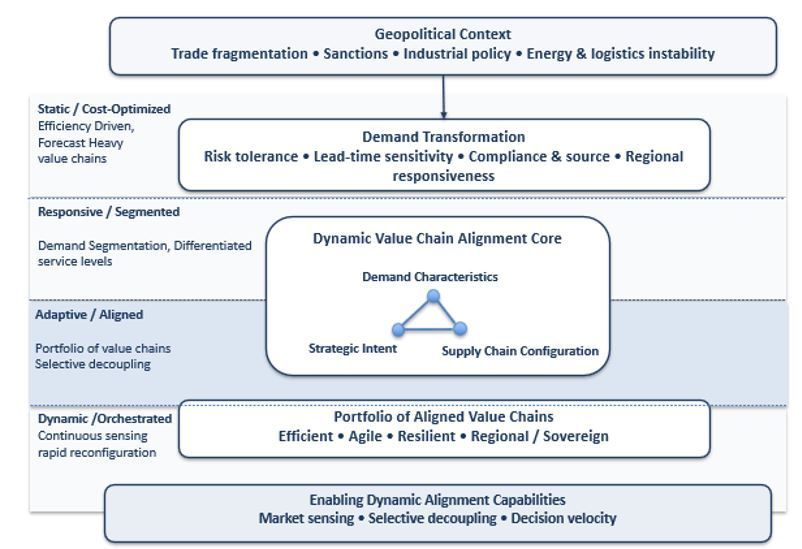
Dynamic Value Chain Maturity Layers (Conceptual Logic) Figure at bottom of the blog Illustrates the Dynamic Value Chain (DVC) framework, positioning geopolitical tension as a structural context that reshapes demand characteristics and necessitates continuous alignment between demand, strategic intent, and supply chain configuration. The framework emphasizes portfolio-based value chain design enabled by dynamic alignment capabilities, including market sensing, selective decoupling, and decision velocity.
From One Network to a Portfolio of Value Chains - Managing a Portfolio of Value Chains
In the spirit of the alignment models that emphasize to converge on a critical insight: competitive advantage increasingly depends on managing a portfolio of differentiated value chains, rather than a single global network. That can be translated into five adaptive levers:
- Market sensing over forecasting - In geopolitically volatile environments, historical data loses predictive power. Continuous sensing of policy shifts, border friction, energy volatility, and customer priorities becomes essential.⁸ DVC capability: Adaptive intelligence
- Demand-first segmentation - Segmentation must extend beyond volume and margin to include tolerance for risk, lead time, compliance, and disruption. Supply chain design should follow segmentation, not precede it.⁴ DVC capability: Strategic segmentation logic
- Portfolio thinking, not single networks - Organizations must operate a portfolio of supply chains: resilient, agile, lean, or fully localized—each matched to a specific value proposition. DVC capability: tailored value proposition per supply chain
- Selective decoupling - Strategic buffers, postponed differentiation, and modular architectures allow organizations to absorb shocks where uncertainty concentrates without excessive redundancy.² DVC capability: Structural resilience by design
- Decision velocity as a strategic asset - Governance, data visibility, and cross-functional coordination determine how rapidly value chains can be reconfigured. In dynamic environments, speed of alignment becomes a source of competitive advantage.⁹ DVC capability: Execution agility
Value Creation Under Persistent Tension
Geopolitical instability exposes the limits of static, efficiency-driven value chains. Designed for scale and predictability, they are increasingly fragile, relative slow to adapt, and misaligned with customer expectations. Dynamic Value Chains offer an alternative. They treat geopolitical tension not as an external anomaly to be buffered against, but as a permanent design constraint—and, potentially, a source of advantage. The objective is not to eliminate complexity, but to deploy it deliberately, where it creates value.
The strategic question for leaders has changed. It is no longer how to protect supply chains from geopolitics, but how to design Dynamic Value Chains that remain aligned, adaptive, and competitive because geopolitics is now part of the system.
Endnotes
- World Economic Forum, The Global Risks Report 2024 (Geneva: WEF, 2024).
- Martin Christopher, Logistics & Supply Chain Management, 5th ed. (Harlow: Pearson Education, 2016).
- McKinsey Global Institute, Geopolitics and the Geometry of Global Trade (New York: McKinsey & Company, 2023).
- John Gattorna, Living Supply Chains (Upper Saddle River, NJ: FT Press, 2010).
- John Gattorna, Dynamic Supply Chains, 2nd ed. (Harlow: Pearson Education, 2015).
- Harvard Business Review, “How Geopolitics Is Rewriting the Rules of Global Supply Chains,” 2022.
- Yossi Sheffi, The Resilient Enterprise (Cambridge, MA: MIT Press, 2007).
- Harvard Business Review, “The End of Forecasting as We Know It,” 2022.
- Harvard Business Review, “Why Speed of Decision-Making Is the New Competitive Advantage,” 2023.